Donostia-San Sebastián promotes the digitalization of parking with the progressive deployment of Smart Parking
Reducing urban congestion with a phased technology strategy
Donostia-San Sebastián improved urban mobility without friction for users thanks to the success of the parking digitization project implemented by Urbiotica.
–
Faced with the need to optimize the use and management of the city’s parking spaces, Donostia-San Sebastián decided to opt for a progressive digitalization by means of intelligent technologiesThe goal was to implement a measurable and scalable system that would be able to deliver results from the early stages of the project. The goal was to implement a measurable and scalable system that would be able to deliver results from the early stages of the project.
The City wanted to test the technology Smart Parking technology for facilitate technical validationHence, the process was divided into three stages. The deployment was developed for our client EYSA, responsible for leading the implementation in Donostia-San Sebastian within the regulatory and operational framework of the Low Emission Zone (LEZ).

Smart Parking in 3 phases: from pilot project to control of strategic parking spaces throughout the city
Through a progressive deployment, Donostia-San Sebastian digitizes more than 700 parking spaces so that parking management and future decisions are based on real data.
–
The project uses interconnected technological solutions to make better use of public space and reduce traffic generated by the prolonged search for parking, an advance that undeniably improves the experience of users and municipal managers.
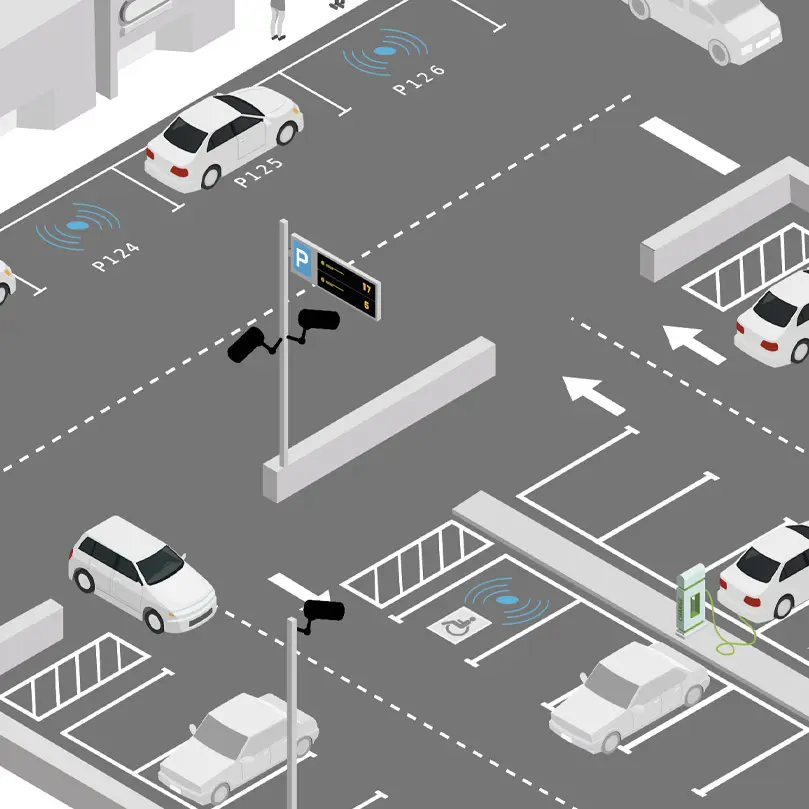
Urbiotica works for EYSA as a technology provider, providing parking detection, guidance and control systems, specifically occupancy sensors and variable signage panels that work in conjunction with a mobile application for users.
First phase: Pilot test of the new intelligent guidance system
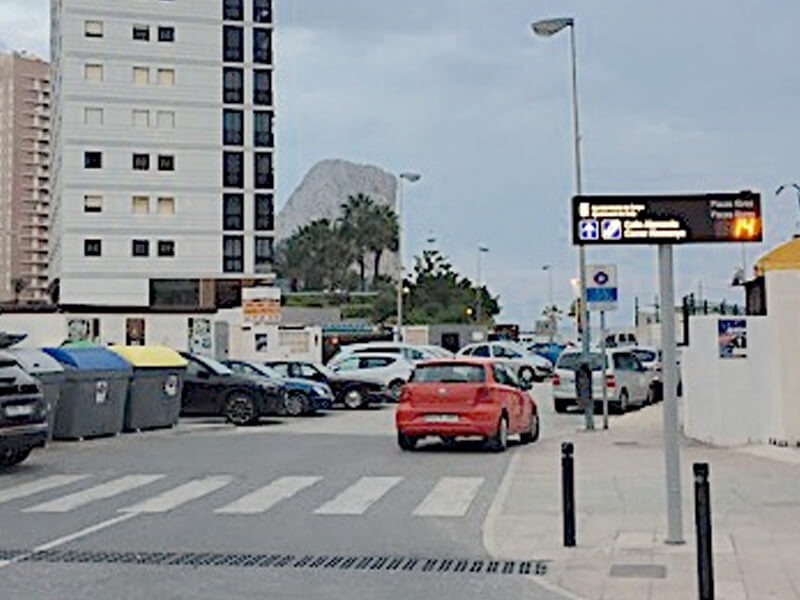
The first phase of the project was planned as a pilot test, starting in a dead-end street located very close to the well-known Chillida sculpture. A total of 126 parking spaces were addressed in the area to validate the operation of the system, installing variable signage panels outside the parking area to show availability before accessing the area.
This makes it possible to anticipate occupancy and saves drivers from unnecessary maneuvers in areas of complex traffic. The positive experience with the pilot project laid the groundwork for subsequent stages of greater scope and complexity.
Second phase: Reliable occupancy data on PRM places
In this phase, the focus was on digitizing PRM regulated parking spaces. In total, 353 detection sensors were deployed in order to obtain reliable data on the occupation of the spaces, generating verifiable usage statistics from which to detect patterns of use, needs and misuse.
In addition to improving parking supervision, this stage provides strategic value in the medium and long term, being able to analyze whether the distribution and sizing of parking spaces reserved for PRM responds to the existing demand.
Third phase: Loading and unloading and Taxis (2026)
The third phase comes into operation in 2026 to extend the scope to more than 230 loading and unloading spaces within the ZBE of Donostia-San Sebastián. The objective is none other than to reinforce access control and the proper use of these spaces through plaza-by-plaza sensors, a mobile application for users and an automatic alert system.
At the same stage, 134 cab ranks in different parts of the city are also being monitored. With the data obtained, it is possible to know how they are used, their schedules and frequencies, so that urban planning is not based solely on estimates.
- Real-time control of parking space occupancy.
- Improved operational efficiency in parking management.
- Reduction of improper use of regulated parking spaces.
- Improved rotation of commercial vehicles in key areas of the city.
.

Frequently Asked Questions
How does Donostia-San Sebastián manage the information of the smart parking system?
All the systems installed in Donostia-San Sebastián are connected to ParkExplorerthe parking management platform parking management platform EYSA’s parking management platform from which the City Council can see which parking spaces are occupied, receive alerts, consult statistics and manage everything in real time.
Can the technology implemented in Donostia be adapted to different types of plazas?
Yes, the devices used in the guidance and control systems of Urbiotica have been designed to obtain the expected results in any parking space. parking. They allow flexible and customized management and configuration according to the the needs of the environment.
What are the advantages of following the phased strategy implemented in Donostia-San Sebastián?
The Donostia-San Sebastián City Council’s phased deployment sought to reduce operational risks and adjust the system to the real needs of the population in a scalable manner. It ensures that each stage generates measurable results before expanding to the entire city.