Rome promotes intelligent enforcement of charging stations for electric vehicles
Preventing the improper use of electric recharging stations in the city
Rome is committed to frictionless electric mobility for users with the deployment of a smart system together with one of the largest operators of charging points in Italy.
–
As electric mobility grows in cities, the need to not only install charging points, but also to ensure that they are available when needed, becomes more visible. Misoccupation is common at fast charging stations, where vehicles remain parked for longer than expected, even after charging is complete.
To solve this turnover problem, the authorities have decided to implement an smart control system in their parking spaces. The objective is none other than to monitor the occupancy status of these spaces in real time in order to provide a more agile service to citizens with electric vehicles.

The digitalization of about 430 recharging stations, of which about 380 are already in operation, has led to improve the use of these and to detect situations of misuse.
–
The intelligent solution installed in Rome goes a step beyond the mere indication of the occupancy status of the parking spaces, it is able to identify whether the vehicle is actually loading or whether, on the contrary, it is simply occupying the space without using it. If the latter is the case, the system sends automatic alerts to the municipal police so that they can act quickly.
The key is to cross-reference occupancy data with information from the charge point management system (CPMS) to check whether a vehicle is connected, whether it is charging and for how long. This leads to detecting: parking lots without charging starting, sessions ended without releasing the space, and stops that exceed the allowed time. As a result, the city has moved from manual to automated, data-driven monitoring.
It is important to differentiate between theoretical availability and actual availability. An EV charging space may appear as “free” if there is no active charging session, but in reality it is unduly occupied. This would cause confusion and therefore frustration for users, so this combination provides a reliable, real-time view that greatly improves the user experience.
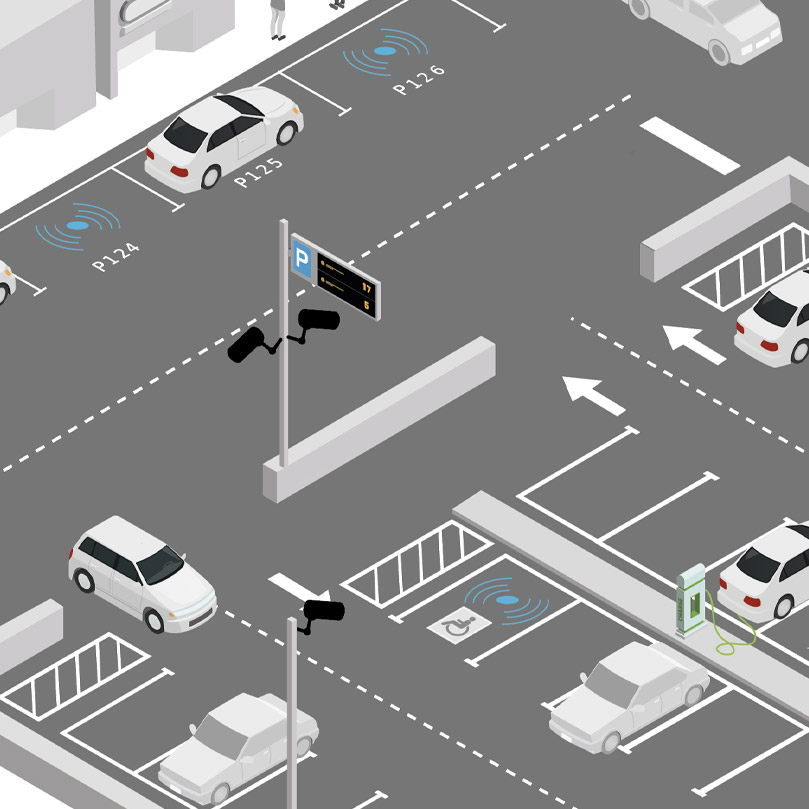
First phase: Pilot test of the new intelligent guidance system
The first phase of the project was planned as a pilot test, starting in a dead-end street located very close to the well-known Chillida sculpture. A total of 126 parking spaces were addressed in the area to validate the operation of the system, installing variable signage panels outside the parking area to show availability before accessing the area.
This makes it possible to anticipate occupancy and saves drivers from unnecessary maneuvers in areas of complex traffic. The positive experience with the pilot project laid the groundwork for subsequent stages of greater scope and complexity.
Second phase: Reliable occupancy data on PRM places
In this phase, the focus was on digitizing PRM regulated parking spaces. In total, 353 detection sensors were deployed in order to obtain reliable data on the occupation of the spaces, generating verifiable usage statistics from which to detect patterns of use, needs and misuse.
In addition to improving parking supervision, this stage provides strategic value in the medium and long term, being able to analyze whether the distribution and sizing of parking spaces reserved for PRM responds to the existing demand.
Third phase: Loading and unloading and Taxis (2026)
The third phase comes into operation in 2026 to extend the scope to more than 230 loading and unloading spaces within the ZBE of Donostia-San Sebastián. The objective is none other than to reinforce access control and the proper use of these spaces through plaza-by-plaza sensors, a mobile application for users and an automatic alert system.
At the same stage, 134 cab ranks in different parts of the city are also being monitored. With the data obtained, it is possible to know how they are used, their schedules and frequencies, so that urban planning is not based solely on estimates.
- Increased vehicle turnover.
- Improvement of the actual availability of recharging points.
- Optimization of the work of the control teams.
- Strengthening regulatory compliance.
.
Frequently Asked Questions
How common is the misuse of electric vehicle charging stations?
Yes, data collected in various projects, in addition to the intelligent monitoring carried out in the electric vehicle charging bays in Rome, show that approximately 1 in 4 vehicles parked in these bays is not charging. Moreover, in almost half of the cases, the electric vehicle occupies the space for more than 30 minutes.
How does this behavior affect electric mobility?
Improper use reduces the rotation of electric vehicles, limiting the real availability of recharging points, as well as identifying critical areas where the demand for control is higher. In short, this type of information allows us to understand user behavior in order to improve both daily operations and future infrastructure planning.
What has the digitization of Rome's recharging stations contributed?
Thanks to the digitalization of the service, new doors are opening to advanced models, such as the automation of control processes or the application of surcharges for excess time. The Rome project reflects these advantages and the importance of accompanying such initiatives with intelligent systems. It is not a matter of deploying more, but of better managing what already exists.